


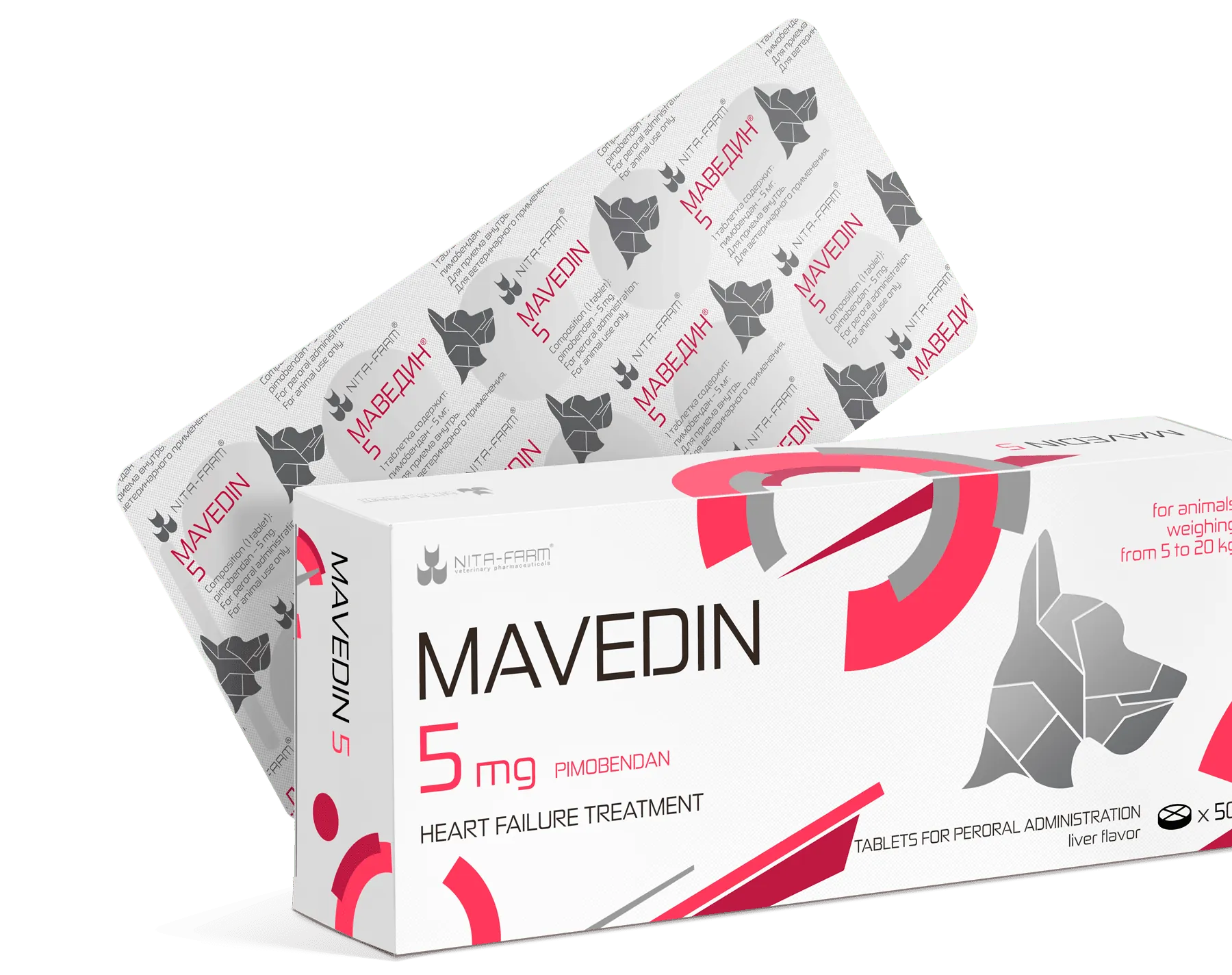

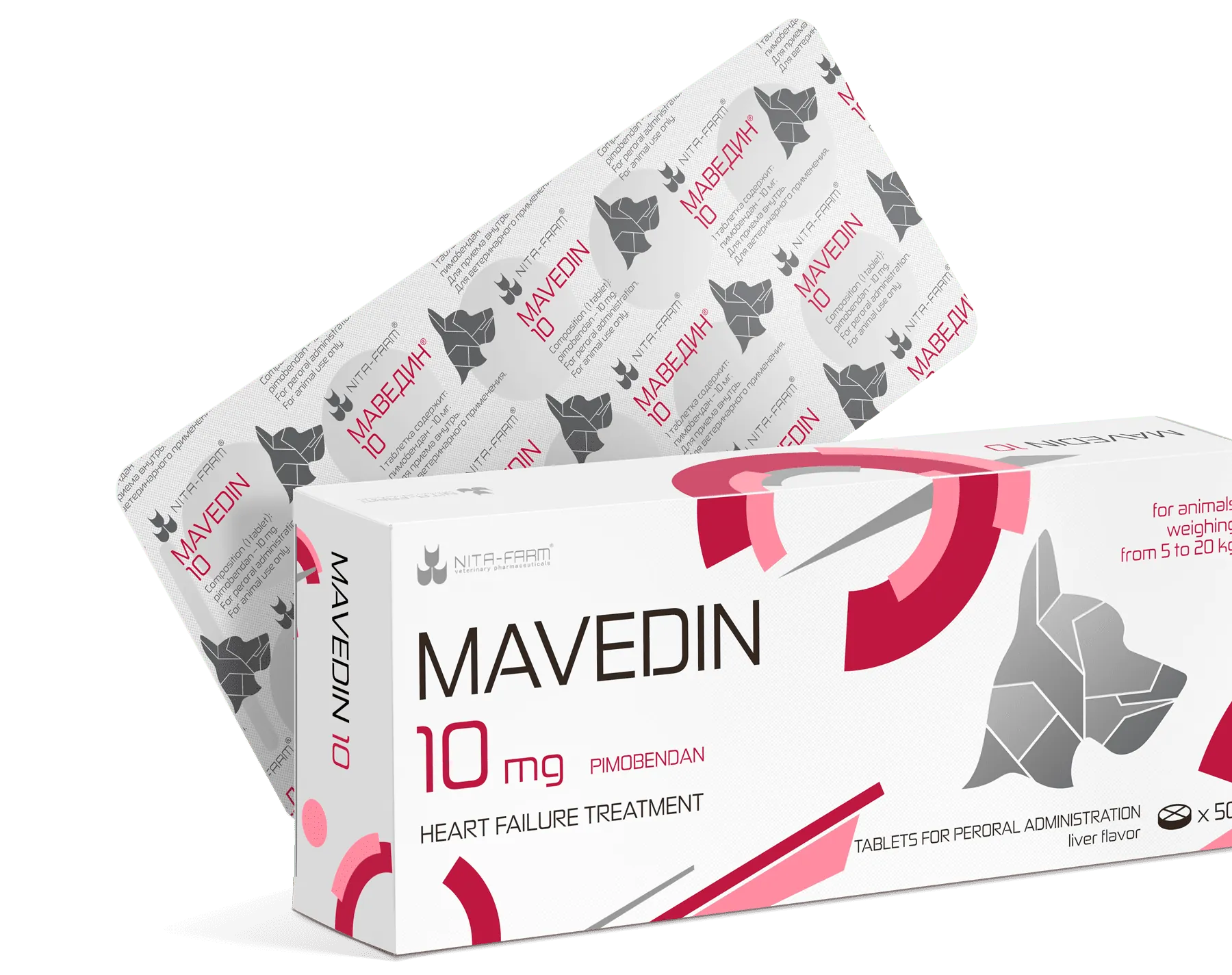


Mavedin
Pimobendan
Pimobendan
Mavedin
Reliable, convenient and simple-to-use veterinary drug with an appealing taste to support your pet in the fight against heart disease insufficiency
- Relieves the symptoms of heart failure and improves the quality of life of your pet
- Increases the strength of heart contractions and has a vasodilating effect
- Accurate dosing due to 3 formats (1.25 mg, 5 mg, 10 mg) and the possibility of dividing the tablet into 4 parts
Composition
Pharmacological properties
Indications
Dosage and method of administration
Restrictions
1 tab Mavedin
1.25 OR 5 OR 10
pimobendan 1.25 mg or 5 mg or 10 mg

يرجى الملاحظة: المعلومات الواردة في هذه الصفحة لأغراضٍ إعلامية فقط. قد تختلف خصائص المنتج والتعبئة وتصميم الملصق والمظهر العام باختلاف المناطق. تواصل مع ممثلينا لمزيد من المعلومات.
Pharmacological properties
Pimobendan is a derivative of benzimidazole pyridazinone and has a positive inotropic and vasodilating (vasodilating) effect. Unlike cardiac glycosides, the positive inotropic effect of pimobendan is due to two mechanisms: increased sensitivity of cardiac muscle fibers to calcium and inhibition of phosphodiesterase III (vasodilating effect).
The use of the drug in heart failure increases the strength of heart contractions and reduces preload and postload of the heart.
يرجى الملاحظة: المعلومات الواردة في هذه الصفحة لأغراضٍ إعلامية فقط. قد تختلف خصائص المنتج والتعبئة وتصميم الملصق والمظهر العام باختلاف المناطق. تواصل مع ممثلينا لمزيد من المعلومات.
Indications
Mavedin is used in dogs
- for the treatment of heart failure caused by dilated cardiomyopathy (DCM) at the asymptomatic (preclinical) and clinical stages of the disease
- with myxomatous degeneration of the bicuspid or tricuspid valve at the clinical stage
- with myxomatous degeneration of the mitral valve at an asymptomatic (preclinical) stage of the disease
يرجى الملاحظة: المعلومات الواردة في هذه الصفحة لأغراضٍ إعلامية فقط. قد تختلف خصائص المنتج والتعبئة وتصميم الملصق والمظهر العام باختلاف المناطق. تواصل مع ممثلينا لمزيد من المعلومات.
Dosage and method of administration
|
Indicators |
Dogs |
|---|---|
|
Dosage |
0.2-0.6 mg ml per 1 kg of animal body weight daily. The daily dosage is divided into 2 equal dosages. |
|
Method and frequency of administration |
Perorally individually 0.5-1 hour before feeding |
|
Treatment period |
The dosage of the veterinary drug, the frequency of use and the duration of the course of treatment are set by a veterinarian individually, depending on the indications, the severity of the disease and the condition of the animal. In case of congestive heart failure, the drug is used in dogs during their whole life with individual dosage selection. |
The most convenient is to use Mavedin 1.25 for animals weighing less than 5 kg, Mavedin 5 - for animals weighing from 5 to 20 kg, and Mavedin 10 - for animals weighing from 20 kg.
|
Animal body weight, kg
|
Daily dosage, mg
|
Number of tablets for daily administration |
|||||
|---|---|---|---|---|---|---|---|
|
Morning dosage |
Evening dosage |
||||||
|
1.25 mg |
5 mg |
10 mg |
1.25 mg |
5 mg |
10 mg |
||
|
Below 3 |
0.6 |
¼ |
- |
- |
¼ |
- |
- |
|
4-5 |
1.25 |
½ |
- |
- |
½ |
- |
- |
|
5-10 |
2.25 |
1 |
¼ |
- |
1 |
¼ |
- |
|
11-20 |
5 |
2 |
½ |
¼ |
2 |
½ |
¼ |
|
21-30 |
7.5 |
- |
¾ |
½ |
- |
¾ |
½ |
|
31-40 |
10 |
- |
1 |
½ |
- |
1 |
½ |
|
41-50 |
15 |
- |
1 ½ |
¾ |
- |
1 ½ |
3/4 |
|
51-60 |
20 |
- |
2 |
1 |
- |
2 |
1 |
|
Above 60 |
30 |
- |
3 |
1 ½ |
- |
3 |
1 ½ |
The recommended dosage to achieve a clinical effect is 0.5 mg per 1 kg of animal body weight per day.
To more accurately determine the dose corresponding to the body weight of the animal, the tablet can be divided along the score lines.
In case of pimobendan treatment of dogs suffering from diabetes mellitus, a regular monitoring of blood glucose levels is recommended.
يرجى الملاحظة: المعلومات الواردة في هذه الصفحة لأغراضٍ إعلامية فقط. قد تختلف خصائص المنتج والتعبئة وتصميم الملصق والمظهر العام باختلاف المناطق. تواصل مع ممثلينا لمزيد من المعلومات.
Restrictions
Contraindications and special instructions:
The use of the drug is prohibited:
- in case of hypertrophic cardiomyopathy and clinical conditions in which cardiac blood output cannot be increased due to functional or anatomical features (for example, aortic stenosis)
- in case of severe liver damage (due to the process of metabolism of the veterinary drug in this organ)
- animals with individual hypersensitivity to the components of the veterinary drug
- the veterinary drug should be used with caution in females during pregnancy and feeding of offspring under the supervision of a veterinarian
يرجى الملاحظة: المعلومات الواردة في هذه الصفحة لأغراضٍ إعلامية فقط. قد تختلف خصائص المنتج والتعبئة وتصميم الملصق والمظهر العام باختلاف المناطق. تواصل مع ممثلينا لمزيد من المعلومات.
Similar products

NEW

NEW


NEW

NEW

NEW

NEW


NEW

NEW

NEW

NEW

NEW


NEW


NEW
