


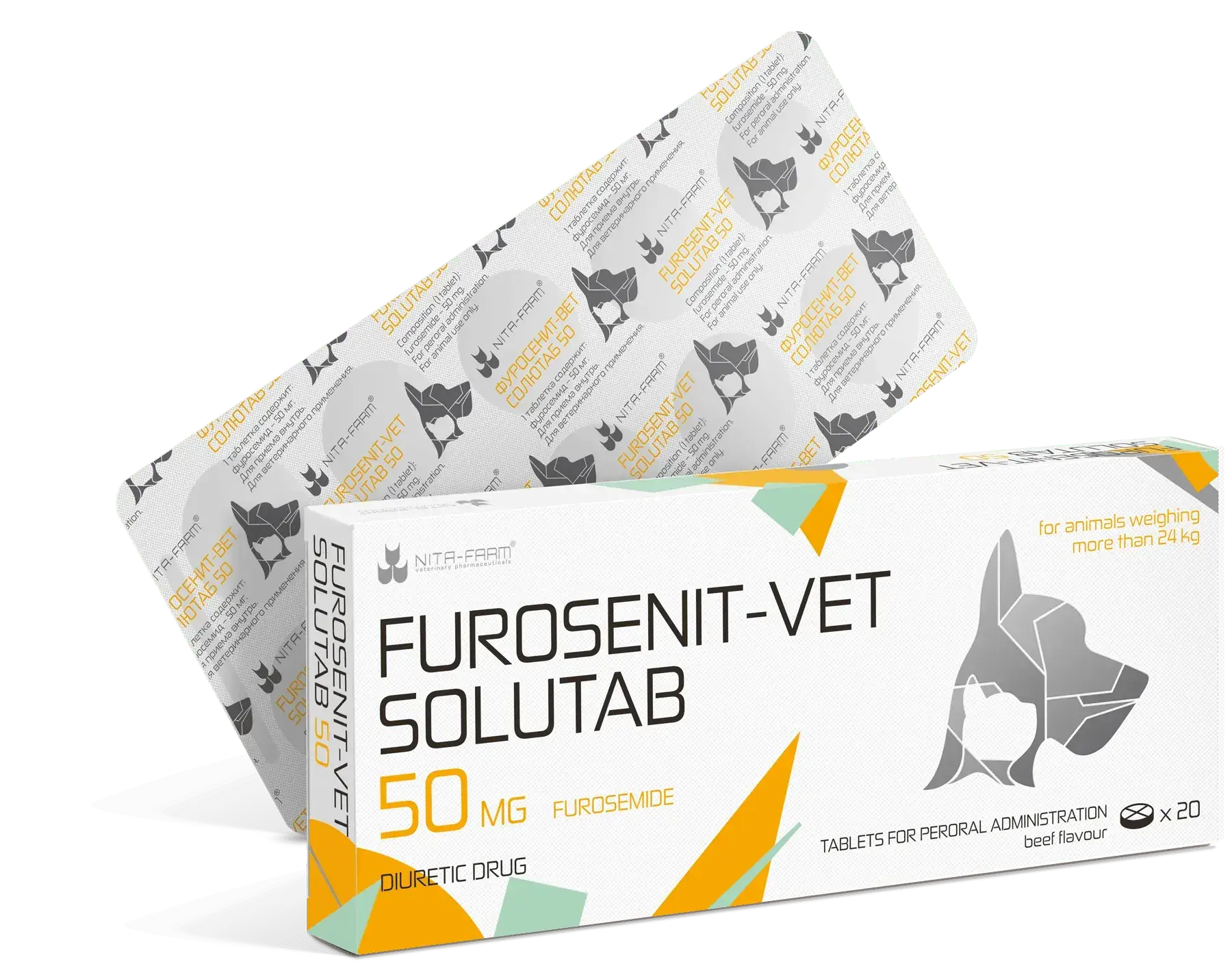


Furosenit-vet Solutab
Furosemide
Furosemide
Furosenit-vet Solutab
Veterinary diuretic based on furosemide in a special form for cats and dogs to treat edema of various etiologies
- Special dosages for a convenient administration
- Can be administered as a tablet or as a suspension
- Appealing smell and taste
- Tablet can be dividing into 4 parts
- Raw material control and production according to GMP standards
Composition
Pharmacological properties
Indications
Dosage and method of administration
Restrictions
1 tab Furosenit-vet Solutab
8 OR 20 OR 50
furosemide 8 mg or 20 mg or 50 mg

يرجى الملاحظة: المعلومات الواردة في هذه الصفحة لأغراضٍ إعلامية فقط. قد تختلف خصائص المنتج والتعبئة وتصميم الملصق والمظهر العام باختلاف المناطق. تواصل مع ممثلينا لمزيد من المعلومات.
Pharmacological properties
Furosenit-Vet Solutab belongs to the fast-acting diuretics of the sulfonamide group. Furosemide blocks the transport system of sodium, potassium, and chlorine ions in the thick segment of the ascending knee of the Henle loop, and therefore its diuretic effect depends on the veterinary drug entering the lumen of the renal tubules (due to the mechanism of anionic transport). The diuretic effect of furosemide is associated with inhibition of reabsorption sodium chloride in this section of the Henle loop. Secondary effects in relation to an increase in sodium excretion are: an increase in the amount of urine excreted (due to osmotically bound water) and an increase in potassium secretion in the distal part of the renal tubule. At the same time, the excretion of calcium and magnesium ions increases.
يرجى الملاحظة: المعلومات الواردة في هذه الصفحة لأغراضٍ إعلامية فقط. قد تختلف خصائص المنتج والتعبئة وتصميم الملصق والمظهر العام باختلاف المناطق. تواصل مع ممثلينا لمزيد من المعلومات.
Indications
Furosenit-Vet Solutab is used in cats and dogs with edematous syndrome of various etiologies, including chronic heart and kidney failure, nephrotic syndrome, liver diseases, severe forms of arterial hypertension and other diseases accompanied by edema.
يرجى الملاحظة: المعلومات الواردة في هذه الصفحة لأغراضٍ إعلامية فقط. قد تختلف خصائص المنتج والتعبئة وتصميم الملصق والمظهر العام باختلاف المناطق. تواصل مع ممثلينا لمزيد من المعلومات.
Dosage and method of administration
|
Indicators |
Cats and dogs |
|
|---|---|---|
|
Dosage |
1-2 times a day at a daily dose of 1-3 mg per 1 kg of animal body weight. If necessary, the dose can be doubled |
|
|
Method and frequency of administration |
Perorally individually, mixed with feed or as a water suspension |
|
|
Treatment course |
Dosage, frequency of administration and treatment course are determined by the veterinarian individually, depending on the indications, the severity of the disease and the condition of the animal. In some cases, prolonged use is possible |
|
To make an administration easier, it is possible to pre-dissolve the tablet (or a part of a tablet) in a small amount of water and administer it using a syringe dispenser or a standard syringe for injection without a needle perorally.

يرجى الملاحظة: المعلومات الواردة في هذه الصفحة لأغراضٍ إعلامية فقط. قد تختلف خصائص المنتج والتعبئة وتصميم الملصق والمظهر العام باختلاف المناطق. تواصل مع ممثلينا لمزيد من المعلومات.
Restrictions
Contraindications and special instructions:
Hypersensitivity of animals to furosemide, other sulfonamides and sulfonamides.
Pre-comatose and comatose state.
Renal coma, glomerulonephritis, renal insufficiency with sanuria.
Violation of the water-electrolyte balance and acid-base balance.
Animals are in a state of dehydration, hypovolemia and hypotension.
Decompensated mitral or aortic stenosis.
Myocardial infarction.
In females during pregnancy and feeding of offspring, the veterinary drug should be used with caution, under the supervision of a veterinarian.
It should be administered with caution to animals with kidney disease.
يرجى الملاحظة: المعلومات الواردة في هذه الصفحة لأغراضٍ إعلامية فقط. قد تختلف خصائص المنتج والتعبئة وتصميم الملصق والمظهر العام باختلاف المناطق. تواصل مع ممثلينا لمزيد من المعلومات.
Similar products

NEW

NEW


NEW

NEW

NEW


NEW

NEW

NEW

NEW

NEW

NEW


NEW


NEW
